


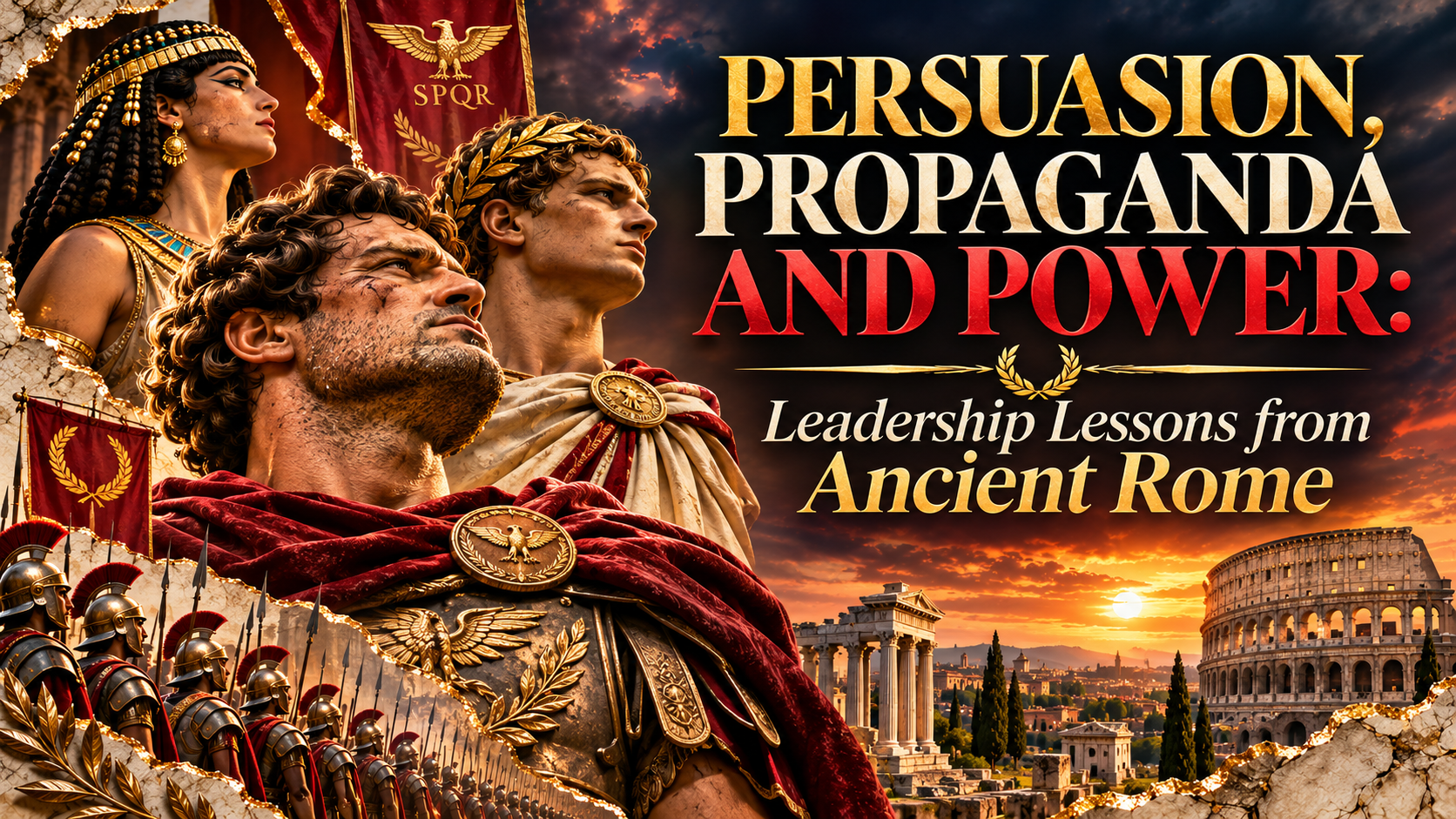
Historical fiction author Brook Allen joins Zoë Routh to explore how persuasion, propaganda, and ambition shaped leadership in Ancient Rome. Drawing on 15 years of research into Mark Antony, Brook examines how political narratives influenced his reputation, how Octavian used propaganda to consolidate power, and why historical accounts do not always tell the full story.
Zoë and Brook also discuss Julius Caesar's charisma, Augustus's political strategy, Cleopatra's influence, and the betrayal of Brutus. From the power of persuasion to the dangers of misplaced trust, they explore what modern leaders can learn about reputation, loyalty, ethical decision-making, and the responsible use of influence.
Discover Brook Allen's Antonius trilogy and her upcoming historical fiction project, The Vesuvius Scroll, alongside Zoë Routh's Power Games: The Leader's Guide to Office Politics and Drama-Free Collaboration.
Summary
Persuasion, Propaganda and the Power of Reputation - How Octavian's political messaging shaped public perception of Mark Antony, demonstrating how controlling the narrative can influence leadership reputations and political outcomes.
Julius Caesar: Charisma, Strategy and Manipulation - How Caesar's military leadership, persuasive communication, and understanding of human motivation helped him command loyalty, while his political misjudgements contributed to his downfall.
Augustus and the Strategic Pursuit of Power - How Octavian balanced calculated political decisions, public image, and organisational ability to consolidate authority while presenting himself as Rome's first citizen.
Loyalty, Betrayal and Invisible Influence - How Cleopatra, Brutus, Roman women, and enslaved people influenced political decisions, relationships, and power structures beyond formal positions of authority.
Ethical Leadership and the Limits of Influence - What Ancient Rome reveals about the difference between persuasion and manipulation, the consequences of unchecked ambition, and why political success does not always reflect responsible leadership.
Thought-Provoking Questions for Leaders, focusing on:
Am I using persuasion to build genuine understanding and commitment, or am I relying on emotional pressure and manipulation to influence others?
How much of my leadership reputation is shaped by my actions, and how much depends on the narratives and perceptions of others?
Am I paying attention to changing loyalties, emerging tensions, and perspectives that challenge my assumptions?
Do I recognise the influence of people without formal titles, and am I creating opportunities for their contributions to be heard?
When making strategic decisions, am I prioritising ethical responsibility and the greater good, or protecting my authority, reputation, and personal ambitions?
Brook Allen reflects on:
Mark Antony's Misunderstood Reputation - How 15 years of researching and writing about Antony revealed a complex military leader whose reputation was influenced by political enemies, lost historical accounts, and Octavian's propaganda.
The Political Influence of Octavian Augustus - How Octavian's ability to control public perception, navigate the Senate, and strategically present himself as Rome's first citizen helped him establish authority during the transition from republic to empire.
Julius Caesar's Charisma and Leadership Blind Spots - How Caesar's military organisation, persuasive communication, and understanding of people's motivations inspired loyalty, while his misjudgement of political opposition and Brutus exposed the limits of his leadership.
Cleopatra, Loyalty and Hidden Political Power - How Cleopatra's intelligence, political relationships, and efforts to protect her family demonstrate the influence of women and others operating outside Rome's formal political structures.
The Contradictions of Ancient Roman Leadership - How military success, political intelligence, slavery, violence, and personal ambition coexisted in Roman society, challenging modern assumptions about effective leadership and ethical responsibility.
Key Quotes
“I don't think he was as bad as some classicists would claim that he was.” - Brook Allen, on Mark Antony
“I think distance, the fog of war, and most of all, the fog of propaganda that Octavian Augustus was so adept at, I think that that really dragged Antony down.” - Brook Allen
“Sometimes as a leader, you do have to put on a face” - Brook Allen
“He had a very clear understanding into the hearts and minds of men” - Zoë Routh, on Julius Caesar
“Character doesn't have to be necessarily good or bad. It's just the way someone is.” - Brook Allen
“Caesar certainly misjudged how, how, how the Senate was turning against him.” - Brook Allen
“Leadership takes a lot of courage. You need to be bold.” - Zoë Routh
Questions Explored
Why was Mark Antony's reputation shaped so heavily by his political enemies, and how did Octavian use propaganda to strengthen his own position?
What made Julius Caesar such a persuasive and influential leader, and where did his understanding of human motivation become manipulation?
How did Augustus use public perception, calculated leadership, and political strategy to consolidate power?
What can the relationships between Caesar, Brutus, Antony, and Cleopatra teach us about loyalty, trust, betrayal, and political influence?
How can modern leaders distinguish effective leadership from ethical leadership when ambition, reputation, and political success do not always align with integrity?
Take Action
Question the Leadership Narrative: Look beyond established reputations and dominant perspectives. Consider who controls the information, whose voices are missing, and how different accounts may influence your judgement.
Use Persuasion with Integrity: Learn from Caesar's understanding of human motivation. Communicate in ways that build genuine commitment rather than exploiting people's emotions, loyalty, or sense of belonging.
Recognise Influence Beyond Titles: Identify the people whose relationships, knowledge, and contributions influence decisions, even when they do not hold formal leadership positions.
Stay Alert to Shifting Loyalties: Caesar's misjudgement of growing political opposition highlights the importance of honest feedback. Encourage different perspectives and remain aware of tensions that could undermine trust.
Balance Strategy with Ethical Responsibility: Augustus demonstrated the effectiveness of political positioning and public image. Consider whether your own decisions align with your values and serve the people affected by your leadership.
Go Deeper:
Explore Zoë’s books: https://zoerouthauthor.com
Enter the Power Games giveaway here
Learn more about Power Games: https://zoerouthauthor.com/products/power-games-paperback
Key Moments
00:00 Welcome to the Show: When Does Persuasion Become Manipulation?
00:38 Power Games Signed Paperback Giveaway Winners Announced
01:43 Planet Zoë: Reflections from a Western Australia Leadership Program
02:35 Poetry, Personal Growth and Radical Change
03:58 Team BUSH: Bold, United, Strategic and Honest Leadership Values
05:29 The Truth Cup: Building Trust Through Honest Feedback
07:39 The Pearl and the Dagger: Manuscript Edits and Kickstarter Preparations
08:50 Meet Brook Allen: Historical Fiction and the Marcus Antonius Trilogy
10:23 Why Ancient Rome? The Contradictions of Roman Society
14:47 Fifteen Years with Mark Antony: Why Brook Chose His Story
16:42 Was Mark Antony Misunderstood? Examining His Leadership and Reputation
20:44 Octavian's Propaganda and the Political Downfall of Mark Antony
24:55 Invisible Influencers: The Power of Enslaved People and Women in Ancient Rome
26:47 Cleopatra and Antony: Love, Loyalty and Political Survival
28:35 Leadership Lessons for Modern CEOs: Julius Caesar and Augustus
30:02 Augustus's Political Strategy: Power, Public Image and Ruthlessness
33:19 Caesar's Charisma: Persuasion, Manipulation and Human Motivation
34:56 Cleopatra in Rome: Political Ambition and Caesar's Leadership Decisions
38:43 Caesar and Brutus: Betrayal, Misjudgement and the Limits of Trust
42:15 Fast Three: Roman Hygiene, Mark Antony and Ancient Curse Tablets
46:39 Brook's New Novel: The Vesuvius Scroll and a Dual-Timeline Mystery
48:19 Where to Find Brook Allen and Her Historical Fiction Books
49:09 Final Reflections, Power Games Giveaway Reminder and Next Episode Preview: Colin Falconer
Related episodes on Power and Leadership
421: The Hidden Rules of Power: Leadership Lessons from Ancient Rome with Fiona Forsyth
420: Why Some Leaders Rise and Others Fall: Lessons from Ancient Rome with L.J. Trafford

About Brook Allen
Author Brook Allen has a passion for history. Brook belongs to the Historical Novel Society and attends conferences as often as possible to study craft and meet fellow authors.
Check out Brook’s website here.
In 2019, her novel Antonius: Son of Rome won a silver medal in the international Reader’s Favorite Book Reviewers Book Awards, then won First Place in the prestigious Chaucer Division in the Chanticleer International Book Awards, 2020.
In 2025, Brook appeared in Season 8 of Blueridge PBS’s WRITE AROUND THE CORNER to present her novel WEST OF SANTILLANE, a story of Julia Hancock, the woman who married explorer William Clark.
Her newest project, THE VESUVIUS SCROLL, is a dual timeline, taking place in the late 1st century BCE and the present day. It’s a thrilling ride through history and real technology that is now being applied to the carbonized scrolls of Herculaneum. (National Geographic, August 2026)

About Zoë Routh
Zoë Routh is a leadership futurist, podcaster, and multiple award-winning author. She works with leaders and teams to navigate future horizons.
She has worked with individuals and teams internationally and in Australia since 1987. From wild Canadian rivers to the Australian Outback, and the Boardroom jungles, Zoë is an adventurist! She facilitates strategy and culture sessions with audacious teams.
Zoë's fourth leadership book, People Stuff - Beyond Personality Problems: An advanced handbook for leadership, won the Book of the Year at the Australian Business Book Awards in 2020. Her fifth book is a near future science fiction dystopian novel, The Olympus Project.
Zoë is the producer of the The Future of Leadership Podcast dedicated to asking “What if…?” and sharing Big Ideas on the Future of Leadership.
Zoë is an outdoor adventurist and enjoys telemark skiing, has run six marathons, is a one-time belly-dancer, has survived cancer, and loves hiking in the high country. She is married to a gorgeous Aussie and is a self-confessed dark chocolate addict.